Visual Storytelling in Your Sales Funnel
.jpg)
Visual Storytelling in Your Sales Funnel: Video Marketing Guide
How to Use Visual Storytelling to Build Trust, Hold Attention, and Move People Through Every Stage of the Funnel
Most sales funnels don’t fail because the offer is terrible. They fail because the experience feels flat, forgettable, or strangely disconnected from how real people make decisions. Visual storytelling helps fix that, because it gives your audience something easier to follow, easier to feel, and much easier to trust.
If you spend enough time around founders, operators, and creative teams, you start hearing the same complaint in different outfits. Traffic is coming in, the product or service is solid, but the conversion still feels softer than it should. That usually means the funnel is explaining, but not connecting. And that’s exactly where storytelling starts to matter.
At its best, visual storytelling turns a cold sequence of pages, emails, and offers into something people can actually move through without friction. It helps a brand tell a story instead of dumping information on the page and hoping the reader figures it out. In a crowded digital landscape, that difference matters more than most teams realize.
What visual storytelling actually means in a sales funnel
Let’s keep this simple. Visual storytelling is the practice of using visuals, structure, sequence, and emotion to guide someone through an idea. In a sales funnel, that means every visual element, from photography to layout to video content, is doing a job. It’s not there just to look polished. It’s there to create clarity, build trust, and guide prospects toward action.
That distinction matters because a lot of brands think “good design” is the same thing as effective storytelling. It isn’t. A beautiful page can still confuse people. A polished sales deck can still feel emotionally empty. And a sleek landing page can still leave a potential customer wondering, “What exactly am I supposed to do here?”
Storytelling in sales works when the funnel moves like a narrative. There’s a clear beginning, a clear tension, and a clear resolution. Your audience sees the pain point, understands the stakes, recognizes the product as a meaningful answer, and feels confident enough to keep going. That’s the real power of storytelling in sales. It makes the path feel natural.
For hospitality brands, this is especially important. People rarely buy a stay, a meal, or an experience based on features alone. They buy atmosphere, identity, and expectation. They want to see themselves inside the story before they commit. Founders selling services or products face the same reality. People don’t just buy utility. They buy a future version of themselves.
Why storytelling works better than plain explanation
A lot of funnels are built like instruction manuals. They explain what the company does, list a few features, throw in a CTA, and call it strategy. Technically, that’s information. Practically, it’s forgettable.
People respond to story because story creates sequence. It helps ideas resonate. Instead of dropping disconnected claims onto a page, you’re showing cause and effect. You’re helping the audience feel something, understand something, and imagine an outcome. That’s far more persuasive than a rushed sales pitch dressed up as a landing page.
There’s also a practical reason this works. Buyers don’t experience a brand in isolated blocks. They move through ads, landing pages, videos, email, social proof, and product pages as one continuous impression. If those pieces don’t feel connected, the funnel starts leaking trust. Using storytelling in sales gives those touchpoints a shared rhythm and a shared point of view.
And here’s where things get interesting. Storytelling doesn’t require some giant cinematic campaign. Even if you don’t have a huge budget, you can still create a strong connection with smart sequencing, thoughtful imagery, and clear narrative structure. Sometimes the most effective visual story is just a focused landing page that knows exactly what it wants the reader to notice first.
The role of video marketing in a modern funnel
If you’re talking about visual storytelling today, you can’t avoid video marketing. Not because every brand needs a dramatic brand film, but because motion is one of the fastest ways to communicate tone, product context, and emotional value. Video can compress explanation. It can show process, mood, proof, and transformation in a way static copy usually can’t.
That doesn’t mean every funnel needs autoplay hero footage and cinematic transitions. Honestly, that’s where many teams overdo it. The goal isn’t to create a video because “everyone says video converts.” The goal is to create a video that earns its place in the funnel. A good video should remove confusion, build trust, or increase desire. If it’s not doing one of those things, it’s probably decoration.
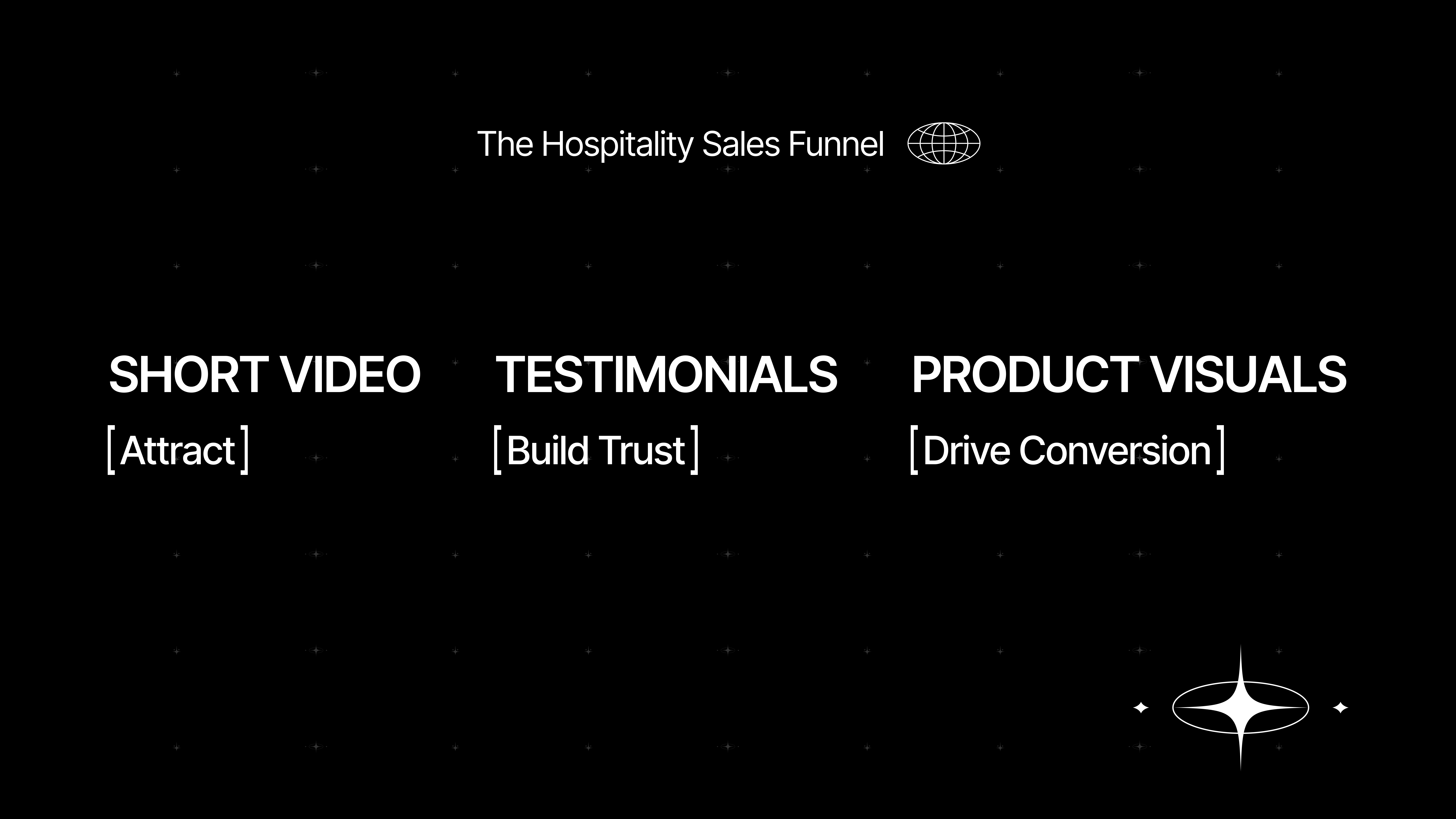
An effective video marketing sales funnel usually uses different storytelling formats at different moments. A short awareness-stage video might grab the audience’s attention through visual contrast or emotion. A mid-funnel explainer might clarify how the offer works. A bottom-funnel proof video might lean on customer testimonials, customer success stories, or behind-the-scenes detail that makes the decision feel safer.
For hospitality brands, video content can be especially persuasive because so much of the sale depends on mood. A room isn’t just a room. A restaurant isn’t just a menu. People want a vivid picture of the experience before they buy. Great visual stories help them imagine arrival, atmosphere, and outcome before the first click turns into a booking.
How visual storytelling fits into every stage of the sales funnel
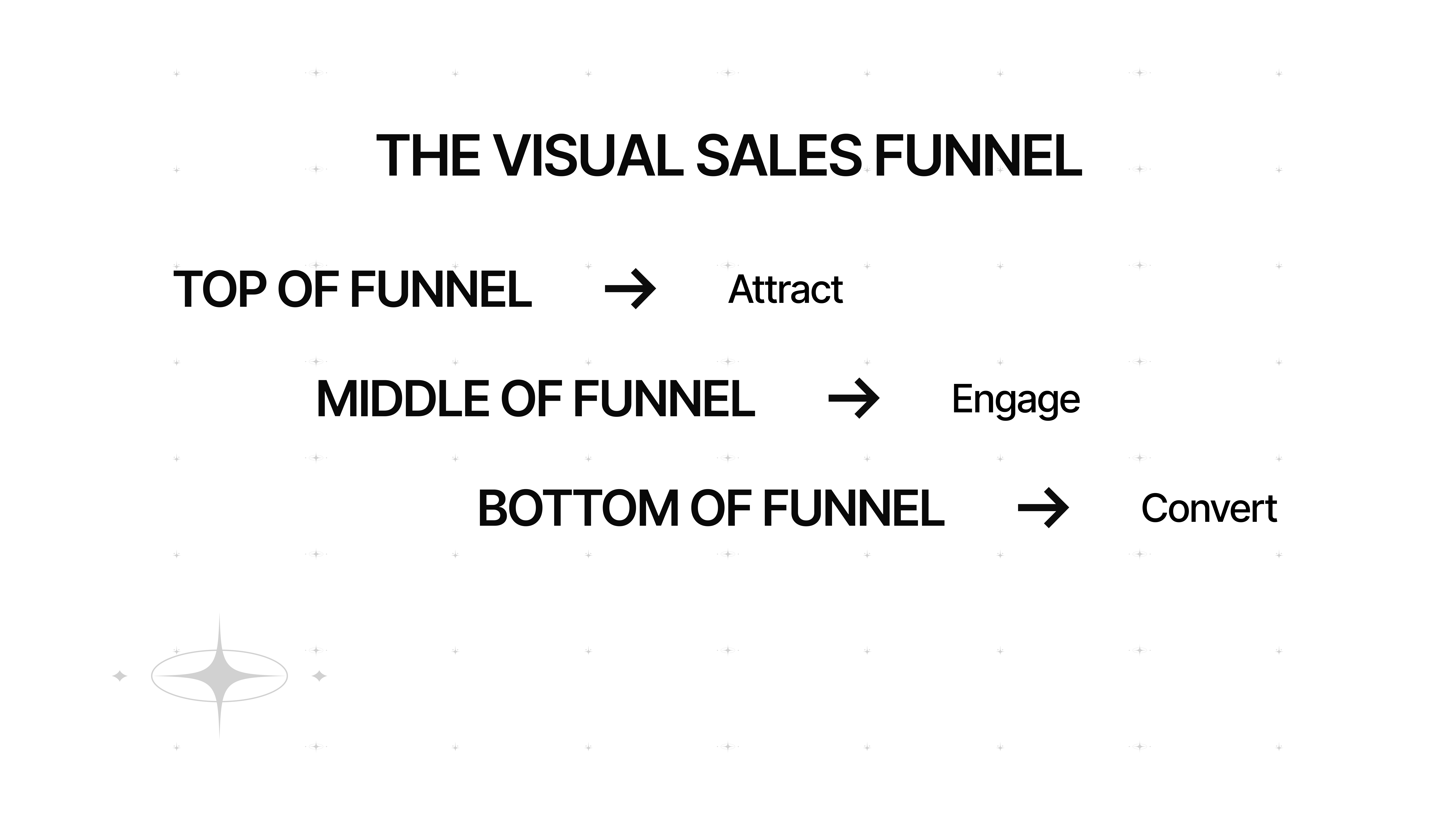
One of the biggest mistakes brands make is treating storytelling like a top-of-funnel branding exercise. In reality, every stage of the sales funnel needs its own version of the story. The format changes, the message tightens, and the emotional job becomes more specific.
Top of funnel, capture attention through visual contrast
At the top of the funnel, your job is not to explain everything. It’s to earn curiosity. This is where a compelling visual, a strong hook, or a clear emotional angle does most of the heavy lifting. People are moving fast, especially across paid social, search, and content marketing channels. If the first moment feels generic, you’ve probably lost them.
This is where visual storytelling examples often go wrong. Brands try to say too much, too early. A better approach is to show the tension quickly. What problem are you helping solve? What aspiration are you inviting people into? What kind of identity does your brand reflect? Good brand storytelling at this stage is less about detail and more about signal.
For example, a boutique hotel brand doesn’t need to explain every room feature in the first visual. It needs to make the right person stop scrolling and think, “That feels like my kind of place.” That reaction is the beginning of the funnel.
Middle of funnel, build trust and provide value
Mid-funnel is where the story needs more structure. You’ve earned some attention, now you need to build trust. This is where using visual proof becomes powerful. Show process. Show outcomes. Show the product or service in context. Show what changes after someone says yes.
This is also where a lot of operators get impatient. They want to jump straight to the offer. But the middle of the funnel is where your audience is deciding whether you understand their pain point well enough to solve it. That means your storytelling strategy needs to answer objections before the CTA tries to close anything.
A useful format here might be:
- Problem
- Tension
- Solution
- Proof
- Next step
That’s a simple template, but it works because it mirrors the buyer’s journey. Your audience doesn’t need more adjectives. They need evidence that the brand understands the problem and can guide them through it.
Bottom of funnel, reduce friction and create urgency
At the bottom of the funnel, storytelling becomes tighter and more practical. The question is no longer “What is this?” It’s “Why should I trust this now?” This is where reviews, customer testimonials, product walkthroughs, pricing context, guarantees, and visual proof all matter.
A lot of brands misunderstand urgency. They think urgency means pressure. It doesn’t. Smart storytelling can create a sense of urgency by making the value of acting now feel clear and logical. A hospitality brand might highlight availability windows or seasonal timing. A service business might show the cost of delay. A product company might show how quickly the result becomes useful.
In other words, the final stage of the sales funnel still needs story. It just needs a more grounded, conversion-oriented version of it.
The best storytelling formats for sales funnels
Different sales need different storytelling formats. That sounds obvious, but it gets ignored constantly. Teams often choose a visual format because it looks nice in a reference folder, not because it supports the job the funnel is trying to do.
Here are a few formats that tend to work well:
- Short-form video for top-of-funnel awareness and emotional framing
- Explainer sequences for product education and service positioning
- Before-and-after visuals for transformation-driven offers
- Customer testimonials for trust and bottom-funnel reassurance
- Case-study style visual stories for higher-ticket or more complex offers
- Sales deck narratives for founder-led selling or B2B conversations
- Interactive landing page flows for premium brands that need stronger immersion
The right format depends on the audience and the complexity of the decision. Founders selling a high-trust service may need a tighter narrative and stronger proof. Hospitality teams often need atmosphere, pace, and sensory storytelling. Creative brands usually benefit from visual media that reflects their brand identity without becoming self-indulgent.
That last part matters. A visual storyteller has to know when to stop. Not every funnel needs five animations, three cuts of video, and a dramatic intro sequence. Sometimes one clean visual hierarchy will outperform a busy experience that tries too hard to impress.
How to tell a visual story without overdesigning the funnel
This is where most businesses get it wrong. They hear “visual storytelling” and immediately think they need more design. More motion. More layers. More polish. But effective storytelling doesn’t come from excess. It comes from clarity.
Start with the emotional question behind the offer. What does the customer want to feel, avoid, become, or solve? That answer gives your visual narrative direction. From there, use visual elements to tell the story in sequence. Show the challenge. Show the shift. Show the payoff. Guide the eye. Remove noise.
A simple way to approach this is:
- Define the pain point clearly
- Show the desired transformation
- Present the product as the bridge
- Reinforce trust with proof
- End with a clear action
That’s not glamorous, but it works. It gives your audience a reason to stay with you, and it keeps the funnel from drifting into empty aesthetic territory. The best visual stories usually feel effortless because the structure is doing the heavy lifting.
And yes, people are more likely to engage when the story feels intuitive. Not because they consciously think, “What a strong narrative arc,” but because the experience feels easy to process. A picture may be worth a thousand words, but only when those words actually needed replacing.
Visual storytelling examples brands can learn from
Think about how Airbnb presents a stay. The platform doesn’t just list features. It frames mood, place, and lifestyle. The visual content helps people imagine themselves inside the experience. That’s visual storytelling doing practical conversion work.
Nike does something similar from a different angle. The product matters, of course, but the brand stories around movement, identity, and effort carry the emotional load. The visuals don’t simply display shoes. They evoke emotions, ambition, momentum, and self-image. That’s why the message tends to resonate with your audience even before the product detail comes in.
Apple is another useful example, mostly because of restraint. The company often uses space, sequence, and product framing to create a compelling way into a story. It doesn’t dump every feature at once. It introduces ideas in stages, which is exactly how a good funnel should work.
You don’t need to copy any of these brands literally. That would be a weird look, and usually not a productive one. But you can study the principle behind them. They understand that visual storytelling uses progression, not just presentation.
A practical framework for founders and creative teams
If you need a more usable framework, here’s one that works well for content marketing, landing pages, and campaign planning.
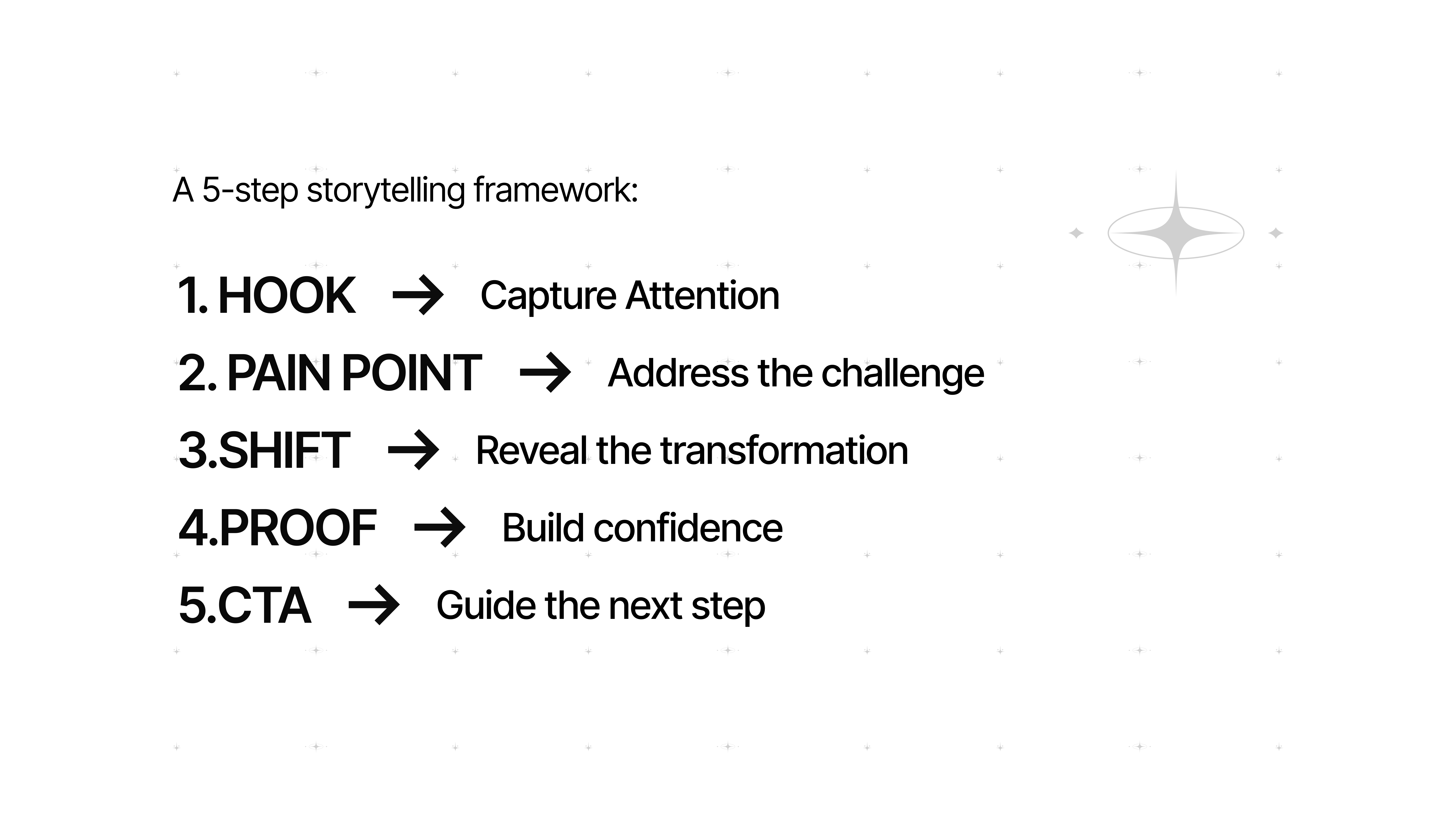
The 5-part visual storytelling strategy
- Hook the eye
Start with a compelling visual or headline that creates immediate relevance. This is about attention through visual contrast, emotional tension, or unexpected framing. - Name the problem
Speak clearly to the pain point. Don’t stay vague. The audience should feel seen, not marketed at. - Show the shift
Use visual stories, examples, process snapshots, or comparison frames to show what changes with your solution in place. - Prove it
This is where trust gets built. Use customer success stories, testimonials, behind-the-scenes visuals, or results in context. - Guide the next step
End by making the path obvious. Don’t bury the CTA in design flourishes. Guide prospects toward a next action that feels natural.
This framework works because it balances emotional movement with business intent. It helps you create content that doesn’t just look smart, but actually moves people.
Common mistakes that quietly weaken conversion
A lot of funnels don’t fail loudly. They fail quietly. They lose energy one section at a time.
One common problem is inconsistency. The ad promises one feeling, the landing page delivers another, and the email follow-up sounds like it came from a different company. That break in tone damages trust. A good storytelling strategy needs continuity across the marketing funnel.
Another issue is visual overload. Teams fall in love with motion, overlays, or visual media that looks exciting in isolation but distracts from the message. Using visual storytelling shouldn’t make the funnel harder to understand. It should make the decision easier.
Then there’s the classic mistake of focusing only on the emotional layer and ignoring clarity. Yes, storytelling should build emotional connections. But it still needs to explain what the offer is, who it’s for, and what happens next. Story without structure is just mood.
Why this matters for hospitality and brand-led businesses
For hospitality brands, visual storytelling is not optional polish. It’s part of the offer. People decide based on feeling long before they compare details rationally. A restaurant, destination, hotel, or premium venue lives and dies on perception, atmosphere, and confidence. You’re not just selling access. You’re selling expectation.
The same goes for founder-led and creative businesses. Often, the real challenge isn’t awareness. It’s translation. You know the offer is strong, but the funnel isn’t helping people feel the value fast enough. That gap is usually a storytelling problem, not just a traffic problem.
So yes, use visual storytelling. But use it with purpose. Build a strong relationship between message, visuals, and action. Let the story support the sale without turning the whole funnel into a performance piece. That balance is where the best conversion work happens.
Final thoughts
The best funnels don’t just inform. They guide. They create movement, reduce uncertainty, and help the audience understand why this product or service matters now. That’s why the power of storytelling in sales keeps showing up across strong brands, strong campaigns, and strong conversion systems.
If you want your funnel to resonate, start thinking like a visual storyteller instead of a page assembler. Don’t just create content. Create sequence. Create meaning. Create a path people can actually follow.
Because in the end, visual storytelling doesn’t replace strategy. It reveals it.

FAQs
What is visual storytelling in sales?
Visual storytelling in sales is the use of images, video, layout, and narrative structure to help a buyer understand and feel the value of an offer. Instead of relying only on explanation, it helps tell a visual story that guides attention and builds trust.
How does visual storytelling improve conversion rates?
It improves conversion rates by making information easier to process and decisions easier to understand. When people can quickly see the problem, the solution, and the outcome, they’re more likely to move forward with confidence.
Is video always necessary in a sales funnel?
No, but it’s often useful when it adds clarity, emotion, or proof. A well-placed video can explain a product, show an experience, or reinforce trust, but weak video can just add friction and slow the funnel down.
What kind of brands benefit most from visual storytelling?
Almost any brand can benefit, but it’s especially powerful for hospitality, lifestyle, premium service, and founder-led businesses. These brands often rely on emotion, atmosphere, and trust, which visual storytelling communicates especially well.
What’s the difference between brand storytelling and funnel storytelling?
Brand storytelling is broader and shapes how people perceive the company over time. Funnel storytelling is more directional and focused on guiding someone through a specific decision with the right message at the right moment.
Can small teams use visual storytelling without a big budget?
Yes, absolutely. You don’t need a massive production setup to tell effective visual stories. A strong structure, thoughtful visuals, clear customer proof, and simple sequencing can do a lot more than an expensive campaign with no narrative discipline.
Migrate from Squarespace to Webflow? Guide & Expert Review
Migrate from Squarespace to Webflow? Guide & Expert Review
Four minutes to the best marketing in Florence
What can a sandwich in Florence teach us about branding and hospitality marketing? A story of hype, human connection, and what brings guests back.

The White Tablecloth Dilemma
A simple hospitality decision revealed how small details shape expectations, influence behaviour and quietly decide who walks through the door.

Share this Blog Article on Social Media
See you
at 8:00.
Laptop optional.
Swimsuit recommended.
Excuses not accepted.
Let’s innovate together!